I’m a theatre nerd. I’m an actor and a playwright and I spend a lot of my days thinking about Eugene Ionesco, Christopher Durang, and Suzan-Lori Parks. Why am I writing a blog about music? Because if Ionesco, Durang, and Parks got together and made a band, it would be Parliament Funkadelic. If you’re a theatre nerd who’s not a P-Funk fan, that ought to get you excited. If you’re not a theatre nerd who’s looking for one last reason to stick with this blog before moving on with your life, bear with me for a few more sentences. What I mean is that P-Funk isn’t just a band. It’s an experience.
In the same way that theatre draws you in with its costumes and its sets and its heightened sense of drama, P-Funk tells a larger-than-life story. They’ve got spacey outfits. They’ve got giant setpieces. But most importantly, they have large theatrical ideas running throughout all of their music. A lot of popular music is pretty pedestrian. You’ve got love songs. Songs about breakups. Even songs about getting back together. But how often do you get to hear songs about funk aliens reclaiming the pyramids? Only when you’re listening to Parliament Funkadelic.
There are three basic things that make P-Funk the theatrical funk juggernaut it is:
Cosmic Mythology
Larger-Than-Life Sound
Crazy Onstage Presence
Let’s explore, shall we?
Cosmic Mythology
Courtesy of Wikimedia Commons
If you’re one of the theatre nerds reading this, you’ll notice that the playwrights I mentioned at the beginning all have certain stylistic leanings. They work in absurdist, surreal, sometimes cartoonishly comedic styles. Parliament Funkadelic plays in the same sandbox. They’re definitely not the musical equivalent of straight-up realistic kitchen sink type drama. Realism definitely has its place in the art world, and there are playwrights and musicians that use it very well. There are some artists, however, who don’t really paint the world as it is. They paint what the world feels like, or what it isn’t, or what it could be. P-Funk falls into this latter camp. In the world of this band, funk is a mystical force that holds mysterious power. It’s a musical world formed by the 1970s, influenced by its politics and sociological environment. But it also manages to transcend the social barriers of the time.
To get a sense of what funk means in the P-Funk universe, you really need to go to the group’s earliest albums. Parliament-Funkadelic is really two different groups sharing one philosophical mindset. Parliament is the smoother R&B version of the funk, and Funkadelic is the more psychedelic rock-tinged iteration. The seed of what the funk is shows up in Funkadelic’s self-titled debut album, on the opening track “Mommy, What’s a Funkadelic?” The song is largely a spoken-word exploration of the Funkadelic aesthetic that includes this line:
“By the way, my name is Funk…I am not of your world…Hold still, baby, I won’t do you no harm…I am Funkadelic, dedicated to the feeling of good.”
People sometimes equate “funky” with “earthy.” The first definition of “funk” in Merriam-Webster is “a strong offensive smell.” It can also mean a “down mood” or “depression.” The history of the word implies something down low, not coming from on high. But Funkadelic sets us all straight by letting us know that the Funk is from another world. If we give ourselves over to it, it will save us.
Courtesy of pixabay.com
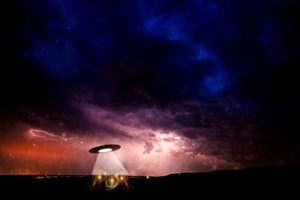
And save us, it does. Five years after Funkadelic introduced the idea that the Funk is an unearthly sentient being, Parliament came along in the mothership with Mothership Connection, an album that introduces more of the mysterious and profound aspects of the P-Funk universe. The title track, “Mothership Connection (Starchild),” depicts an alien spaceship piloted by an alien funk messiah named Starchild. He’s come to collect the true believers, the faithful funkateers of the world. The song contains the repeated haunting refrain,
“Swing down, sweet chariot, stop and let me ride,”
Courtesy of Wikimedia Commons
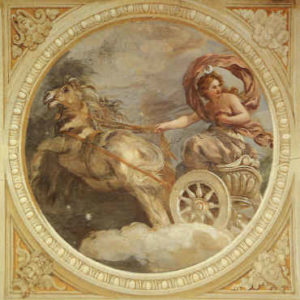
a reference to the spiritual “Swing Down Sweet Chariot,” which is an adaptation of the even older spiritual “Swing Low, Sweet Chariot.” A flying saucer may not be the first thing everyone pictures when they think of a heavenly chariot, but P-Funk’s not concerned with what’s normal. This is a group that likes to imagine the possibilities. Their music is about what the world could be. The spiritual salvation that comes in the most unlikely places. Anyone feeling disenfranchised by the world can hop onto the mothership and free themselves through the Funk. Doing the “loose booty” and saving their souls in the process.
This music came out of a decade that was just starting to become aware of the ways disenfranchised people can empower themselves. The Black Power movement, gay liberation, and women’s lib were just coming into their own. The idea of taking words from a slavery-era song about getting free and repurposing them into a spacey funk jam was revolutionary and powerful. George Clinton, the mastermind behind Parliament Funkadelic, explained his concept for the album like this:
“We had put black people in situations nobody ever thought they would be in, like the White House. I figured another place you wouldn’t think black people would be was in outer space. I was a big fan of ‘Star Trek,’ so we did a thing with a pimp sitting in a spaceship shaped like a Cadillac, and we did all these James Brown-type grooves, but with street talk and ghetto slang.”
The P-Funk world is a world where anything can happen, all made possible by the Funk. People can be whoever they want to be, unhindered by the oppressions of the “realistic” world.
Courtesy of pexels.com
The possibilities of the Funk as a liberating force are further explored in Funkentelechy Vs. The Placebo Syndrome. The title of this album might sound like pure nonsense (I mean, it kind of is), but it’s also a meaningful exploration of a key P-Funk theme: Being An Individual Vs. Fitting In. The mythology of this is epitomized in the tale of Sir Nose d’Voidoffunk, a sad soul who “just can’t find the beat.” His epic journey is depicted in “Flashlight,” one of Parliament’s biggest dance hits. Sir Nose begins the song attempting to go to sleep due to the fact that he will never dance, but a chorus of funksters soon helps him find the funk. By the end of the song, Sir Nose is awake, dancing, and chanting “flashlight,” “red light,” “neon light,” etc. He now understands that “everybody’s got a little light under the sun.”
At the end of the day, that’s what the Funk and the theology of P-Funk is all about. The Funk may be otherworldly, it may even come from outer space, but its power and its potential lie in all of us. We find the Funk when we tap into our individuality and refuse to get steamrolled by the conformists of the world.
Courtesy of Wikimedia Commons
Once you discover the inner potential of Funk, then you are able to see the various ways it is employed throughout the universe as well as the forces that seek to destroy it. The liner notes of Funkadelic’s One Nation Under a Groove detail “The Funk Wars 1984 B.C.,” in which the evil Barft Vada attempts to outlaw funk and make disco the only music anyone ever listens to. However, the brave Jasper Spatic defeats him with a Throb Gun that unleashes the Funk.
There are many tales of the ongoing struggles between the forces of funkiness and unfunkiness, if you know where to look. There’s the tale of “Rumpofsteelskin,” who is so unfunky that “he don’t rust and he don’t bend.” There’s the story of “Dr. Funkenstein,” whose funk is the best. The mythology is vast, and you could basically get a Ph.D. in it.
Theatre is all about large ideas. Myths that explore the larger truths of the human condition. The Greeks explored their myths through theatre. Parliament Funkadelic carries on that tradition through a quirky kind of theatre of their own. Full of larger-than-life characters fighting epic battles of the soul. Liberating through the world through dance, rhythm, and individuality. A whole universe of colorful, absurd science fiction. And if you’re going to build a universe, it’s going to take a lot of people to do it…
Larger-Than-Life Sound
Copyright 2009 Carlos Varela
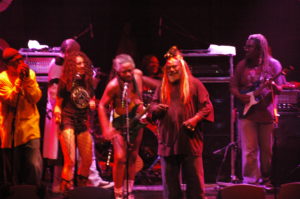
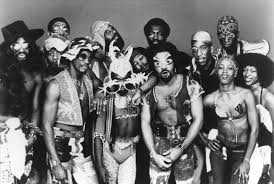
Over the years, P-Funk has employed a small nation in its quest to share the Funk with the masses. Countless members have been part of both Parliament and Funkadelic over the years. Live shows have often featured 30 people onstage at once. P-Funk songs generally aren’t small, intimate affairs. There were plenty of singer-songwriters in the 1970s who gave you small and intimate. Listening to P-Funk is like listening to the cast album of some spectacular experimental Broadway musical. There are storylines, strange, emphatic lyrics, and even dialogue between characters. You’re not just getting a one-sided bit of confessional poetry. You’re getting an immersive world of voices, sound effects, and practically every musical style you can think of.
Courtesy of Wikimedia Commons
Don’t get me wrong. Funk is definitely the genre of P-Funk. But Parliament Funkadelic found a way to expand the definition of funk while remaining true to the foundation established by funk pioneers like James Brown and Sly and the Family Stone. P-Funk definitely stays in touch with the basic concept of the One, the emphasized downbeat that drives the rhythm of any good funk song. However, the fact that their sound is so all-encompassing that they need two different groups to cover the full scope of it says a lot about their versatility.
Parliament is the R&B-influenced, more obviously danceable group. Their name evolved from the Parliaments, the doo-wop group that eventually blossomed into the P-Funk movement. The Parliaments started in the 1960s with a relatively traditional pop sound. Some artists can only do the crazy stuff, and some stick only to the straightforward. When you listen to the Parliaments, you get an appreciation of how much sonic ground this group can really cover. In fact, it’s very easy to trace the evolution of their sound, since Parliament recorded several songs originated by the Parliaments. All of a sudden, driving uptempo pop songs get grooved up into atmospheric funk. The traditional doo-wop vocal stylings evolve into something much stranger and more theatrical. The journey from the Parliaments to Parliament is a story of artists finding their Funk.
Courtesy of pexels.com
Funkadelic is a whole other world of sonic freedom. Originally the backing band for the Parliaments, they eventually became the more experimental and trippy wing of a group that was already pretty trippy and experimental. The music is less driven by melody and traditional formal considerations. Sometimes it’s just a long, weird ramble through amorphous musical and vocal ideas. It’s more heavily influenced by rock than Parliament. One of its most well-known songs, “Maggot Brain,” features a stunning guitar solo from Eddie Hazel that would influence many rock guitarists to come. While Funkadelic was perfectly capable of getting just as danceable as Parliament, they make their versatility clear by proclaiming, “Who Says a Funk Band Can’t Play Rock?!”
This is what happens when you assemble a gigantic team of dynamic artists willing to do their crazy, weird thing. You get a dramatic landscape that reaches operatic proportions. You get country music. You have a song that includes an extended whistling solo. You get such a wide variety of music that it’s impossible to pin it all down into one thing and define it. If it’s one thing, it’s funk. It’s not always the funk that Tower of Power or Kool and the Gang would recognize. But it is an inimitable expression of individualism. It’s flying in the face of whatever the accepted norms are, because the norms aren’t there for you. It’s telling the world just how weird you really are and daring them to be okay with it.
Theatre is about personalities. Characters that are wild, entertaining, relatable. While some music strives to be general enough that anyone can see themselves in it, P-Funk is specific enough that everyone can be themselves in it. Seeing people be wildly creative frees you to do the same. Which leads me to my last point…
Crazy Onstage Presence
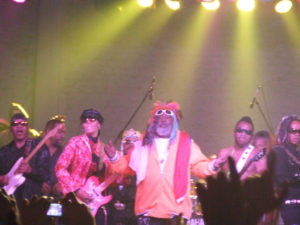
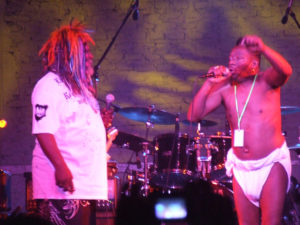
A lot of bands put on wild shows. KISS is an obvious one that comes to mind, with their makeup and pyrotechnics. David Bowie helped pioneer the glam rock movement. But Parliament Funkadelic is in a class all its own. Sure, they had wild cosmological lyrics. They had a dynamic sound. But the stage show is where they truly became the avant-garde theatre ensemble they were always threatening to be. If you’re going to go onstage to sing a song called “Cosmic Slop,” you better look the part. You better wear a giant fuzzy green hat. Or maybe a diaper.
Copyright 2009 Carlos Varela
The P-Funk world is a world where anyone can be what they want to be. But how do you convey that message onstage? You wear the weirdest, most colorful outfits imaginable. You stretch the limits of what is acceptable so that everyone can get in where they fit in. How can anyone feel embarrassed or self-conscious when they’re surrounded by people in shiny space costumes?
And how can you be a proper space person without proper transport?
Courtesy of Wikimedia Commons
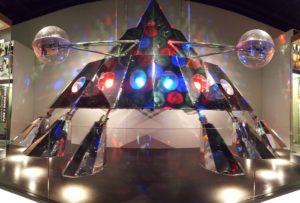
The landing of the mothership was a signature moment for Parliament Funkadelic concerts in the 1970s. It took a key thematic concept of the band’s music and made it real for the fans. In the theatre, that’s what we call”spectacle.” It’s the kind of moment that ties together all the themes and ideas explored by a piece of theatre and sums it up in one giant memorable stage picture. P-Funk is here to bring all the true believers home. Here’s the mothership to prove it.
It was such a memorable element of P-Funk stage shows that the Smithsonian acquired it and now displays it in its National Museum of African American History and Culture. If that doesn’t say something about the staying power of P-Funk, what will?
I See the Mothership Comin’!
In conclusion, P-Funk is awesome because there is nothing about it that can ever be duplicated. It’s a cosmic belief system, a musical genre unto itself, and an onstage spectacle to rival any Broadway musical. It takes all the things I love about theatre and makes something new and exciting out of them. It’s strange and foreign, yet familiar and relatable in surprising ways. It’s a musical movement that celebrates all that is funky about the individual.

0 Replies to “The Theatricality of P-Funk”