Parliament Funkadelic may be one distinctive artistic identity, but it’s also a collective of many individuals. P-Funk is a recognizable brand and movement. It’s also composed of countless artists who’ve come and gone over the course of several decades. How have so many different people with unique talents come together to form a cohesive whole? The world may never fully understand. I blame it on the Funk. Let’s take a closer look at some of the idiosyncratic personalities that have shaped this group’s journey.
George Clinton
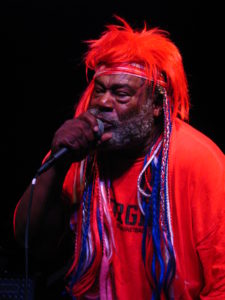
Any discussion of the legacy of P-Funk is impossible without this guy. He is undoubtedly the mastermind behind Parliament Funkadelic. The leader of the chaos. It would be wrong to attribute the entirety of P-Funk’s artistic identity to him, but he is the one who guided it from day one.
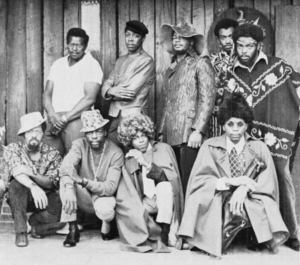
It all began in the 1950s when a teenage George Clinton formed The Parliaments, a doo-wop group inspired by Frankie Lymon & The Teenagers. The Parliaments, named after the cigarette brand, initially entertained patrons at the barbershop where George worked in Plainfield, New Jersey. With George as their manager, they recorded several songs throughout the 1960s in a smooth doo-wop style. As the group became more successful, he also took a job at Motown Records as a songwriter and producer. In 1967, they finally had a hit–“(I Wanna) Testify,” a song that would later be funkifized by the group in the 1970s.
George briefly lost the rights to the name “Parliaments” due to a contractual dispute, so he formed another group called Funkadelic. This group was the beginning of George’s unabashedly funky endeavors. They burst into the early 1970s with a psychedelic blend of funk and rock that would change funk-lovers’ lives forever.
Shortly afterwards, George reclaimed the Parliaments brand, shortening the name to “Parliament.” This group contained all the members of the original Parliaments as well as the newly formed Funkadelic. However, Parliament carved out a distinct identity of its own, combining the smooth, melody-driven aesthetic of the Parliaments with the wild funk-rock sensibilities of Funkadelic. Thus, George built a funk empire, containing a multitude of sounds and styles while still maintaining a consistent P-Funk quality.
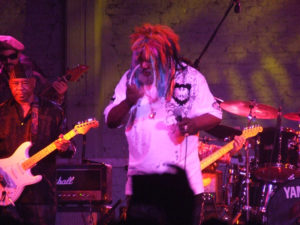
As the 1970s wore on, the various members of Parliament and Funkadelic peeled off, and the groups disbanded in the early 1980s. That’s when George began a solo career, creating such oddly funky hits as “Atomic Dog” and “Do Fries Go With That Shake?” He also produced music for other artists, including the Red Hot Chili Peppers’ album Freaky Styley.
He’s since become a noteworthy pop culture figure. His work has been sampled by many hip-hop artists, and he’s popped up in cameos in films like PCU, Good Burger, and Freaknik: The Musical. He was inducted into the Rock and Roll Hall of Fame in 1997 with 15 other members of Parliament Funkadelic. He still tours with his P-Funk cohorts, spreading the good news of the Funk.
While he’s well-respected for his contributions over the past decades, he’s still making new things and connecting with the younger generation of musical artists. He recently appeared on Kendrick Lamar’s song “Wesley’s Theory,” from the critically acclaimed album To Pimp a Butterfly. He has inspired countless funky souls with his offbeat clothes and hairstyles, his off-kilter sensibility, and his sense of vision and purpose. He knew what the Funk could be, nurtured it along the way ever since that barbershop in Plainfield, New Jersey. We are forever grateful to him for daring to stray from the beaten path and reinvent an entire musical genre.
Bootsy Collins
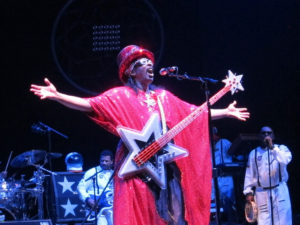
The starpower of George Clinton is undeniable, but you could make a pretty solid argument that Bootsy Collins is just as much of a star in his own right. Like George, Bootsy formed a band in the 1960s with childhood friends. This one was called The Pacemakers, and they developed a solid reputation as a funk band.
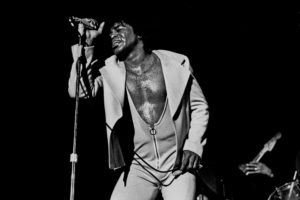
So solid that in 1970 the Godfather of Soul himself, James Brown, hired them as his backing band. They were rebranded as the J.B.’s and were featured on some of James Brown’s most iconic songs, including “Get Up (I Feel Like Being a) Sex Machine,” “Super Bad,” and “Soul Power.” These songs feature driving funk and playful interactions with the band, two features that show up in some of the liveliest P-Funk songs. The original J.B.’s played with James Brown for 11 months, with Bootsy as the bassist.
Once Bootsy’s time with the J.B.’s ended, he started another group called the House Guests, which caught the attention of George Clinton. Several of the original members of Funkadelic had left by 1971, so he invited the House Guests to join in on the Funk. Thus, Bootsy Collins’s P-Funk career was born.
Bootsy had a long and fruitful collaboration with George and his P-Funksters, indulging in his weirdness and creativity to augment the weirdness of P-Funk. His contributions completed the artistic mission of the group in invaluable ways. Bootsy’s bass-playing was featured on most of Parliament and Funkadelic’s albums in the 1970s and 1980s.
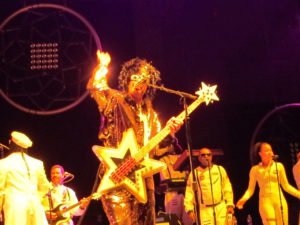
Bootsy brought his knowledge of the One, that essential funk downbeat, to the proceedings. His funk sensibility was his own, but it was honed and refined in the fires of the James Brown kiln. James Brown’s form of funk was tighter, more restricted and disciplined. It had a show-business/entertainment emphasis, whereas P-Funk was more about exploring the spiritual truth of the Funk, no matter how weird it got. Bootsy brought the show-biz flash to the group. But where he was restricted and kept under a tight leash in the James Brown world, he was free to play and indulge in the realm of George Clinton. He was able to wear star sunglasses and big, flashy hats. He made the One more noticeable than it was in James Brown’s work. Whereas the One was sort of hiding in the background in a lot of James Brown’s songs, it was loud and proud and unmistakable in Parliament Funkadelic.
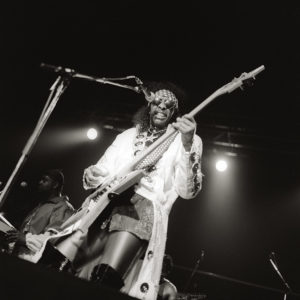
Once Bootsy had spread his brand of Funk to the P-Funkateers, he decided to branch out and begin a solo career. Forming a splinter group with some P-Funk musicians called Bootsy’s Rubber Band, he developed his own singular style. While James Brown and P-Funk live in the DNA of Booty’s Rubber Band, they’re also their own thing. P-Funk may have Sir Nose d’Voidoffunk and Dr. Funkenstein, but Bootsy has Casper the Holy Ghost and Bootzilla. The mythology’s not quite as complex, and the “jam” quality of the music is much more present. The music is freer in its exploration of ambiguity and theory. Specifically “The Pinocchio Theory,” which contributes a key theme to Funk theology: “If you fake the Funk, your nose will grow.”
This is ultimately what Bootsy brought to the P-Funk stew: an unfailing sense of authenticity. Steeped in know-how from one of the most well-respected practitioners of funk at the time and liberated by a newly minted funk visionary, he knew what the Funk was in theory and practice. Given the opportunity to set the Funk flying free, he did so, and the results were magical.
Bernie Worrell
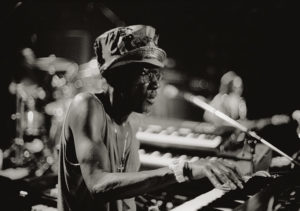
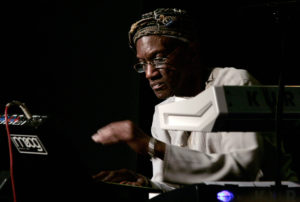
The late, great Bernie Worrell. Keyboardist and composer for Parliament Funkadelic. Once referred to as “the kind of sideman who is as influential as some bandleaders.” Bernie was born for funk greatness. Beginning piano lessons at three years old and writing a concerto by age 8, Bernie was always the real deal. He was trained at Juilliard and brought an artistic virtuosity to P-Funk that sent the sound over the edge.
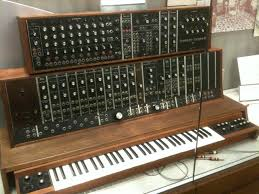
Like many of the P-Funksters, he came to the group with some prior band experience. He was a member of Chubby & The Turnpikes, which eventually became Tavares. Yes, that Tavares. The one that sang “Heaven Must Be Missing an Angel.” Don’t know it? Yeah, it’s a little too disco for the target audience of this blog. Well, anyway, Tavares went in one direction, and Bernie went another. A native of Plainfield, New Jersey (the birthplace of The Parliaments), Bernie eventually met up with George Clinton and joined the P-Funk adventure. Bernie applied his versatile musical genius to the arrangements of both Parliament and Funkadelic. He played grand piano, Wurlitzer electric piano, Hohner clavinet, Hammond B3 organ, ARP String Ensemble, and MOOG Synthesizer. He employed all manner of cutting-edge fancy electronic gadgets to create the signature P-Funk spacey, atmospheric, otherworldly sound.
Perhaps the most famous contribution Bernie made to the P-funk oeuvre is his use of the Minimoog synthesizer on the Parliament hit “Flashlight.” All that crazy weird electronic stuff you hear throughout the song? That’s him. How did he make that delightful combination of sound? Only Bernie knows for sure, but what we do know is that he used three connected synthesizers to do it. No one had ever heard anything quite like it before, and it influenced much of the R&B to come, as well as new wave, new age, and techno. “Flashlight” is one of the most sampled songs in the hip-hop world, showing up in songs like Digital Underground’s “Doowutchyalike,” 2Pac’s “Let Them Thangs Go,” and C+C Music Factory’s “Things That Make You Go Hmmmm…”
Bernie’s synthesizers show up prominently in plenty of other P-Funk masterpieces, including “Mothership Connection (Star Child)” “Aqua Boogie,” and “Give Up the Funk (Tear the Roof off the Sucker).” There is no doubt that he is a central component of the P-Funk sound. George Clinton was the ringleader, Bootsy Collins brought the rhythmic structure and glamtastic sensibility, but Bernie is the one who gave P-Funk its rich sonic landscape.
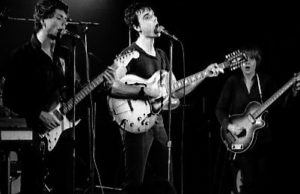
As P-Funk activity started to wind down in the 1980s, Bernie was recruited by the Talking Heads and became an unofficial member of the band. His musical stylings can be heard on the albums The Name of This Band Is Talking Heads and Speaking in Tongues as well as their concert film Stop Making Sense.
Of all the notable P-Funksters, Bernie’s probably been able to adapt the best to multiple styles. He’s collaborated with Sly & Robbie, Fela Kuti, and Jack Bruce. He was part of the original house band for The Late Show with David Letterman. He’s also gone off and done his own thing, starting a group known as Bernie Worrell and the Woo Warriors. There’s also been a Bernie Worrell Orchestra.
What is the Bernie Worrell legacy? He’s a man who discovered sounds no one knew existed. He found the musicality of advanced technological instruments and changed the game forever. He became one with the Funk and was one of its greatest ambassadors. As his colleague Bootsy Collins said,
“Bernie is one that would become whatever sound he touches…if he hit a sound that’s like a trumpet, he becomes a trumpet player. If he hits a sound that’s like a string, he becomes a string section…whatever sound he hits, he becomes that.”
The Next Funk Generation
P-Funk has left in its wake a variety of disciples who have taken up the mantle of the Funk and continue to preach it to the masses. Here are a few artists working in styles similar to P-Funk you really should check out:
Prince
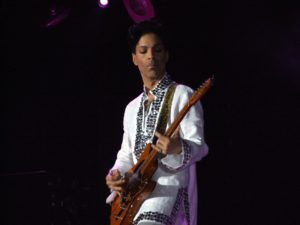
Prince arrived on the scene in the late 1970s, while P-Funk was enjoying its final years of prolific output. The funk lineage is undeniable. The penchant for outrageous colorful clothing, the tendency to play different characters in his songs. Most importantly, Prince’s music was liberating in the sense that it didn’t conform to traditional social roles. Prince wore makeup and high heels. He often sang in a falsetto. He was also masculine. He was shockingly frank in singing about sex, but he also sang a lot about God. What’s going on here? There are no rules! Prince was funky and free to say and do whatever he wanted to. Where did he get that from? I’m not saying Parliament Funkadelic was the reason Prince could do what he did, but they certainly helped smooth the path at least a little bit. Coincidentally, Prince was quite friendly with much of the P-Funk gang. George Clinton recorded an album on Prince’s Paisley Park record label, and he covered Prince’s song “Erotic City” for the soundtrack of the film PCU. In fact, Prince inducted Parliament Funkadelic into the Rock and Roll Hall of Fame in 1997, explaining in his speech that “Erotic City” was inspired by seeing a live P-Funk performance of “Knee Deep.” Just one example of how the Funk is the gift that keeps on giving, from generation to generation.
Janelle Monae
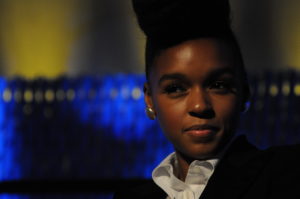
Parliament Funkadelic were one of the pioneers of the concept album. And in this age of digital music, Janelle Monae has somehow managed to continue to make the concept album relevant. Metropolis: Suite I (The Chase), The ArchAndroid, and The Electric Lady are extended explorations of a science fiction world in which an android attempts to help the citizens of a mechanized world get in touch with their humanity. Androids are an oppressed minority in this world, and they stand in as a metaphor for a variety of real-life marginalized groups. Her music provides people the opportunity to celebrate what makes them different, all while dancing to a funky beat. Sound familiar? Janelle Monae’s adventures in Afrofuturism call to mind similar sci-fi capers from the P-Funk canon. Her music also makes it just as okay to be yourself as any of the most affirming P-Funk jams. Janelle Monae’s “Q.U.E.E.N.,” in which she embraces her weirdness and shuns the haters, feels a lot like the mothership coming down to collect the true believers.
The Funk Lives On
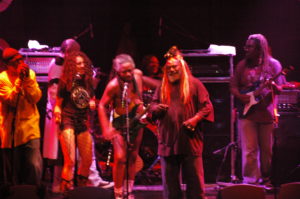
Have I missed anyone important in my discussion of the P-Funk legacy? Yes, I have. Probably at least 30 people. How on earth could I have written this blog and not mentioned Eddie Hazel? Or Garry “Diaperman” Shider? Michael “Kidd Funkadelic” Hampton? The Brides of Funkenstein?
There’s a gigantic P-Funk universe out there. I encourage you to explore it. This is just a springboard for an exciting P-Funk adventure. I began my adventure years ago thanks to a Good Burger cameo, a chance hearing of “Atomic Dog” on the radio, and an insatiable thirst for Funk. May this blog set you on a similar path to enlightenment.
0 Replies to “The Many Faces of Parliament Funkadelic”